Strategy 12 min
Website Not Generating Leads? Fix the System Behind It
If your website is not generating leads, the design is rarely the real problem. The issue is usually the disconnected business system behind the site.
Read
Tom Beachell
Director
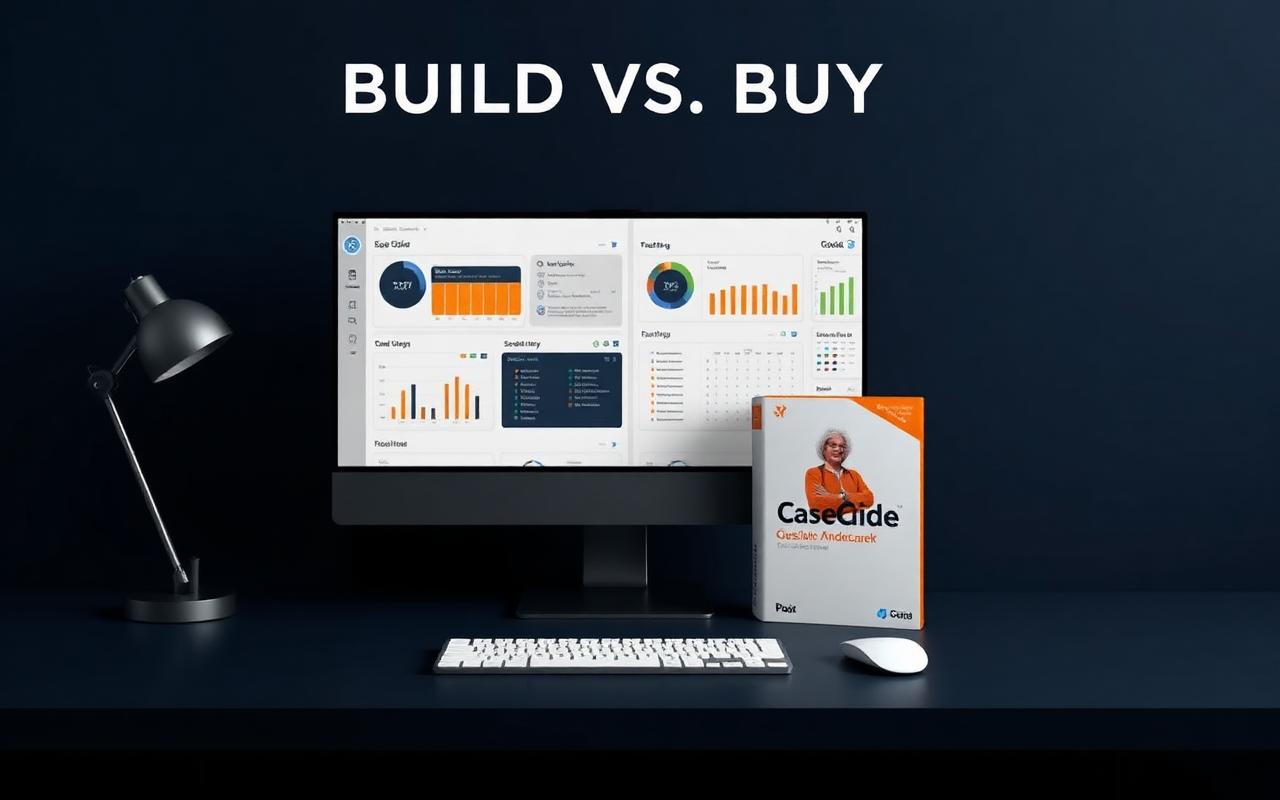
Every growing business reaches a point where spreadsheets and email folders can't keep up. You need a CRM — but should you buy one off the shelf or build something custom? The honest answer isn't as binary as most agencies would have you believe, and the wrong choice can quietly cost a UK business tens of thousands of pounds over three to five years in licensing, lost productivity and migration regret.
We've helped UK companies replace bloated Salesforce instances with lean bespoke systems, and we've also told prospects to stay on HubSpot when that was clearly the right call. This guide is the framework we use internally to decide which way to go — and how to spot the warning signs that you're outgrowing one model and need the other.
Off-the-shelf CRMs like HubSpot, Salesforce, Pipedrive, Zoho and Monday Sales CRM offer immediate functionality. They're proven, well-supported, integrate with hundreds of tools out of the box, and — crucially — they let a small team get to value within days rather than months. For businesses with standard sales processes, fewer than 20 users and contact volumes under ~25,000, a bought CRM is almost always the right starting point.
Typical UK pricing in 2026 sits between £30–£150 per user per month for mid-tier solutions, plus £5,000–£20,000 of implementation if you bring in a certified partner. Annual total for a 10-person team usually lands at £8,000–£38,000 fully loaded. The product roadmap is funded by thousands of other customers, which means you get continuous feature releases, security patches and integrations without paying for any of them directly.
Buying also defers a category of decisions that small teams aren't equipped to make: data model design, hosting, backup, access control, GDPR documentation. The vendor solves all of that for you. If your differentiation as a business has nothing to do with how your CRM works, that's a sensible trade.
Custom CRMs become compelling when your business processes don't fit standard moulds. If you're a recruitment agency with a unique candidate-to-client pipeline, a property company with complex vendor and tenant relationships, a manufacturer with multi-stage order workflows, or any business where the CRM is genuinely operational software rather than a glorified contact list — you'll spend more time fighting an off-the-shelf platform than using it.
The build cost for a bespoke CRM typically ranges from £15,000–£60,000 depending on complexity, with most UK mid-market projects landing around £25,000–£45,000. There are no per-user fees, no feature restrictions, no marketplace tax on integrations and no dependency on a third party's product roadmap. You own the source code, the database and every workflow inside it.
Just as importantly, you own the data model. When your sales director says 'we need to track this new attribute against every deal, broken down by region, and trigger a different approval flow for contracts over £50k', you change it. You don't open a support ticket, wait three days, and discover it requires the enterprise tier.
What vendors don't advertise in their pricing pages: per-hour customisation fees (£200–£500/hour for certified Salesforce developers, £150–£300/hour for HubSpot specialists), data migration complexity when you eventually move, integration maintenance whenever an API changes, feature bloat that slows team adoption, and the constant risk of price increases buried in renewal contracts.
One client came to us after Salesforce nearly tripled their licensing costs at renewal. The increase was technically within the terms they'd signed three years earlier. They had two choices: pay, or undertake a six-month migration of a system that had become load-bearing for their entire commercial operation. They paid. Then they came to us to plan a phased exit.
Add to this the soft costs nobody quantifies: training every new hire on a complex interface most of them won't use 80% of, paying for seats that sit dormant because someone left and you forgot to deactivate them, and the steady accumulation of zombie automations and stale custom fields that nobody dares delete in case something breaks.
Custom CRMs are not free after launch. Budget 15–20% of the build cost annually for hosting, maintenance, security patching and small feature additions. A £30,000 build realistically costs another £4,500–£6,000 a year to keep healthy. That's still typically cheaper than the equivalent SaaS bill at the same scale — but it's not zero, and pretending otherwise sets the wrong expectations.
You also need a clear specification before building. Scope creep is the single biggest risk in custom CRM projects: the team starts adding 'nice to haves' mid-build, the timeline doubles, the budget overruns, and the eventual system tries to be everything to everyone. The way we control this is by shipping a tightly-scoped phase one (usually the core pipeline, contact model and one or two integrations) within 8–12 weeks, then layering additional modules in 4-week increments based on what the team actually uses.
And finally, you need someone to own the system internally. Not necessarily a developer — but a product-minded person who can prioritise feature requests, write clear briefs and say no to scope creep. Without that, even the best-built CRM drifts.
Rather than 'build vs buy' as a binary, we use four diagnostic questions:
1. How standard is your sales process? If a generic pipeline of 'Lead → Qualified → Proposal → Negotiation → Closed' covers 80% of what you do, buy. If you have multiple parallel pipelines, recurring revenue logic, complex stakeholder mapping or sector-specific stages (legal matter management, recruitment candidate flow, property vendor cycles) — build.
2. How deeply does the CRM need to integrate with your other systems? Off-the-shelf CRMs are great for connecting to mainstream marketing tools. They struggle when you need real-time, two-way sync with bespoke quoting engines, internal ERP, custom job-management software or sector-specific platforms. If those integrations are central to how the business runs, custom usually wins.
3. How fast are you growing? Per-seat pricing punishes growth. A 10-person team at £80/seat/month is £9,600/year. A 40-person team at the same rate is £38,400/year — for the same software. If you're tracking toward 30+ users within 24 months, the SaaS bill compounds in a way that quickly makes a build look cheap.
4. How sensitive is your data, and how regulated is your sector? Legal, financial services, healthcare and government-adjacent work often need data residency, granular access controls and audit trails that go beyond what standard SaaS plans provide without expensive add-ons. Custom systems can be designed against your exact compliance posture from day one.
For a 20-person UK team, growing to 35 over five years, with around 80,000 contacts and three meaningful integrations:
HubSpot Professional + Operations Hub (realistic mid-market config): £18,000–£24,000/year in year one, scaling to roughly £40,000–£55,000/year by year five as seats and contact tiers increase. Five-year total: £150,000–£200,000.
Salesforce Sales Cloud + Service Cloud with a partner-led implementation: £35,000 implementation, then £25,000–£70,000/year in licences depending on tier and add-ons. Five-year total: £180,000–£300,000+.
Bespoke CRM build: £35,000 build, then ~£6,000/year maintenance. Five-year total: £65,000.
The bespoke option isn't always cheaper — for a 5-person team that stays at 5 people, HubSpot Starter will beat it comfortably. But at mid-market scale with growth ahead, the gap is rarely small.
If your sales process is standard, your team is small, and the CRM is supporting the business rather than running it — buy. Start on HubSpot or Pipedrive, get to value fast, and don't overthink it.
If your processes are genuinely unique, your team is growing past 20–25 users, you need full control of the data model, and the CRM is becoming operational infrastructure — build. The upfront investment pays back inside two to three years and the strategic optionality (own integrations, own data, own roadmap) is permanent.
If you're not sure, do this: stay on the bought CRM for now, but spend three months documenting every workaround, every manual process, every 'we can't do that in the system' moment. That list becomes the specification for a custom build when the cost of the workarounds exceeds the cost of replacing the platform. For most growing UK businesses, that point arrives between year two and year four — and the ones who plan for it in advance migrate calmly, instead of in a panic when a renewal letter lands.
If you want a second opinion on which side of the line your business sits on, we'll happily review your current setup and tell you honestly — including when staying put is the right answer. Get in touch for a no-obligation conversation.
Get Started
Book a free infrastructure audit. We'll map your current systems, identify gaps, and show you exactly how a connected digital platform can transform your business.
Prefer to talk? 01904 900201
Real UK price bands for a custom-built CRM, what moves the cost, and the point at which building beats subscribing.
Where each platform actually wins, the point at which building becomes the cheaper option, and the questions that decide it.
The buy-first, build-later path most UK SMEs should follow — and the specific signals that mean you have outgrown it.