
Strategy 12 min
Website Not Generating Leads? Fix the System Behind It
If your website is not generating leads, the design is rarely the real problem. The issue is usually the disconnected business system behind the site.
Read
Tom Beachell
Director
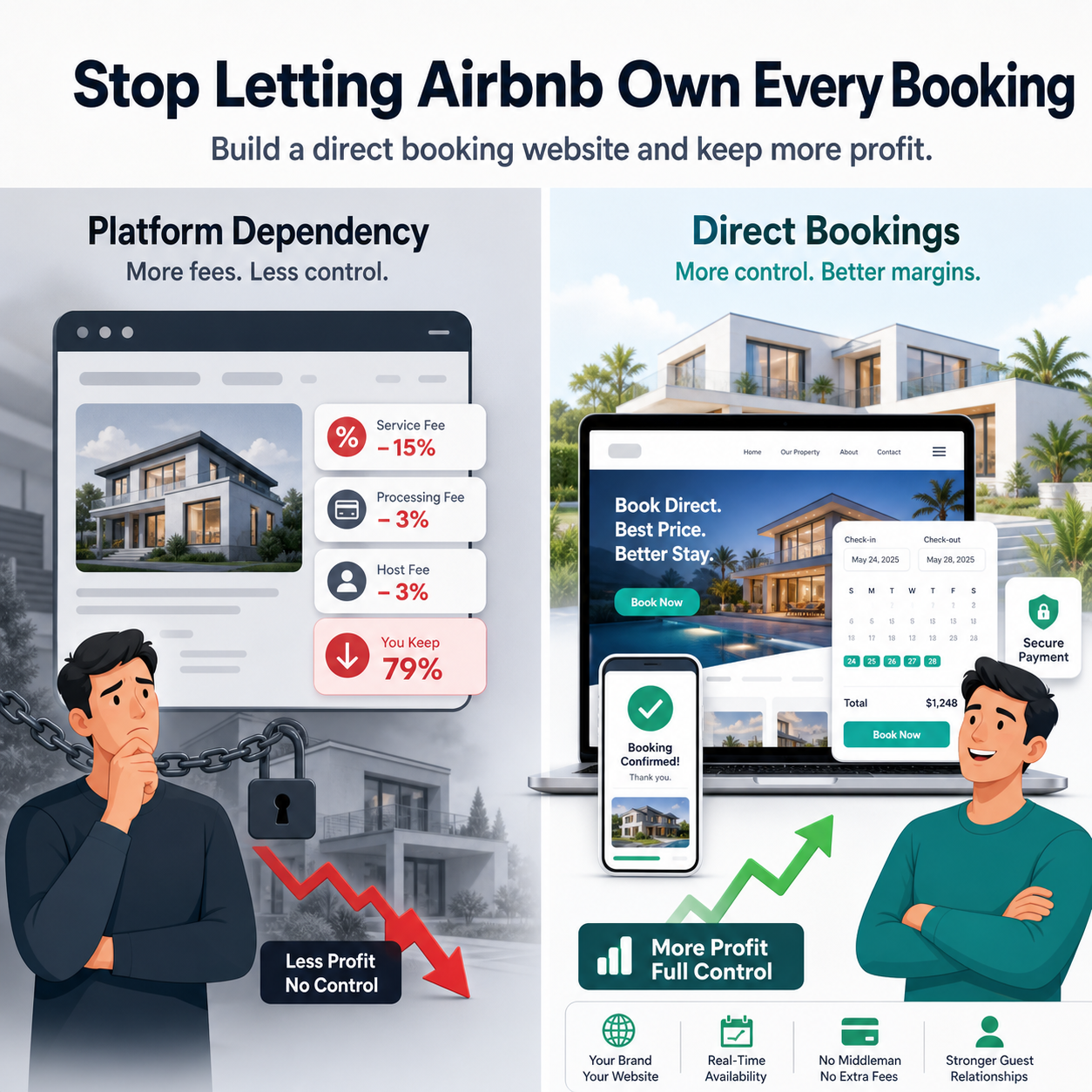
If you host on Airbnb, you already know the platform is a double-edged sword. It brings exposure, trust signals and a steady stream of first-time guests. But it also takes a meaningful slice of every booking, pushes you toward discounts you didn't plan to offer, and quietly puts your business at the mercy of an algorithm you don't control.
Learning how to reduce Airbnb costs isn't really about shaving a few percent off a service fee. The bigger opportunity is reducing your dependency on Airbnb in the first place — keeping it as a marketing channel while building a direct booking system you actually own.
The smartest hosts we work with haven't left Airbnb. They've reduced their reliance on it. They use Airbnb to fill calendar gaps and win first-time guests, then convert repeat stays into direct bookings through their own website. The result is higher margins, better guest relationships and a business that doesn't wobble every time Airbnb changes the rules. (For wider context on the hospitality and short-stay sector we work with, see our sector page.)
The visible Airbnb host fee is only part of the story. The real cost is margin erosion across multiple line items, plus the strategic cost of platform dependency.
Here's where the money quietly leaks:
Add it up and a 'small' 3% host fee can easily translate into a 25–35% effective cost once discounts, guest fees, refund risk and lost repeat business are factored in.
Before you change channels, fix the fundamentals. These are the operational levers that improve margin on every booking, regardless of where it comes from.
Dynamic pricing tools like PriceLabs or Wheelhouse are useful, but don't hand over full control. Set sensible minimums based on your true cost per night (mortgage, bills, cleaning, amortised maintenance, your time). If a booking doesn't clear that floor, it isn't profit — it's subsidy.
Audit your weekly and monthly discount settings. A 20% weekly discount combined with Airbnb's guest fee and your host fee can easily turn a profitable booking into a break-even one. Reduce or remove discounts and watch what actually happens to occupancy — most hosts find demand barely shifts.
Cleaning is usually the largest variable cost. Standardise turnover checklists, build a linen rotation system, and negotiate fixed rates with cleaners rather than hourly. Schedule maintenance proactively to avoid expensive emergency call-outs that eat a whole booking's profit.
A 5-night booking costs roughly the same to service as a 2-night booking but generates far more revenue. Set a minimum stay that reflects your real economics, and price mid-week gap-fillers attractively to stitch shorter bookings into longer ones.
Empty nights are pure cost. Use same-day turnovers where your cleaning team can support them, and price aggressively to fill orphan nights between confirmed bookings.
Better photos, a sharper title, and a clearer description will lift your booking rate without a single price change. A higher conversion rate means you can hold pricing firm rather than discount to compete.
Smart locks, automated messaging and channel managers save real hours. But avoid automation that removes the personal touch — guests who feel looked after leave better reviews and are far more likely to rebook directly next time.
Revenue is vanity. Profit per booking is the number that matters. Build a simple spreadsheet that nets off every fee, discount, cleaning cost and consumable. You'll quickly see which bookings, channels and seasons are actually paying you.
Flexible policies look guest-friendly but expose you to last-minute cancellations that are hard to refill. A Firm or Strict policy on premium dates can protect significant revenue.
A returning guest is the cheapest, most profitable booking you can take. Make every stay memorable enough that the guest wants to come back — and make it easy for them to find you again outside Airbnb.
Operational tweaks help. But the structural way to reduce Airbnb costs is to take a meaningful share of your bookings directly, through your own booking website.
Direct bookings let you:
The point is simple: when a guest books directly, you can earn more and the guest can pay less. The 15–20% that would have gone to platform fees gets split between margin and discount — a win for both sides.
A direct booking website is no longer a 'nice to have' for short-term rental operators. It's the single highest-leverage investment you can make to reduce Airbnb fees and protect your business long-term. We cover this in detail on our bespoke website development and conversion-optimised websites pages.
A proper vacation rental website should include:
Crucially, your website doesn't have to replace Airbnb. It works alongside it. Airbnb wins you new guests; your website keeps them.
Building the website is step one. Driving bookings to it is the real work. The tactics that consistently move the needle:
Never breach Airbnb's terms of service — don't try to divert a live Airbnb enquiry off-platform. The play is post-stay, with guests who already love your property.
Let's run a realistic comparison on a 4-night stay at £160 per night. Numbers are illustrative.
Booking via Airbnb (host-only fee model):
Same booking direct via host's website:
The guest saves about £140. The host earns about £57 more. Both sides win — only Airbnb loses out. Multiply that across 40 bookings a year and you're talking thousands of pounds back into the host's pocket, and a much happier repeat-guest base.
The hosts who struggle to improve margin tend to make the same mistakes:
If you want to act on this, here's the sequence we recommend to hosts and serviced accommodation operators:
Step 1: Calculate your current Airbnb costs. Pull 12 months of payouts and work out your true effective fee, including discounts, refunds and lost repeat business.
Step 2: Improve pricing and operational efficiency. Tighten discounts, raise minimum stays where appropriate, and standardise cleaning costs. Many operators automate these workflows with business process automation.
Step 3: Create a direct booking website. A proper vacation rental website with live availability, secure payments and trust signals — not a one-page brochure.
Step 4: Set up secure payments and booking management. Stripe for payments, a channel manager to sync calendars, and clear booking terms. For more complex multi-property operations, a custom booking system often makes more sense than off-the-shelf software.
Step 5: Optimise the website for local SEO. Build pages targeting your town, your property type and the kind of guest you want.
Step 6: Build a guest email list. Capture emails at booking and post-stay, with proper consent, and send useful updates twice a year. A simple CRM keeps this organised as your guest base grows.
Step 7: Encourage repeat direct bookings. Offer returning guests a small discount or perk for booking direct — still cheaper than the Airbnb fee.
Step 8: Track direct booking revenue monthly. Aim to grow direct bookings from 0% to 20%, then 40%, then beyond as your repeat base compounds.
Most hosts who follow this plan see direct bookings overtake Airbnb within 18–24 months — without ever delisting from the platform.
Reducing Airbnb costs isn't really about clipping a few percent off a service fee. The real opportunity is structural: build a direct booking channel that compounds in your favour, then use Airbnb as the marketing engine that feeds it.
Hosts who do this end up with better margins, stronger guest relationships and a business that isn't one algorithm change away from a bad quarter. Hosts who don't end up working harder every year just to stand still.
If you're serious about how to reduce Airbnb costs and increase direct bookings, the next step is straightforward: get a proper vacation rental website live, point your repeat guests at it, and start keeping more of every booking. Book a free discovery call to scope it out.
You can't change Airbnb's published host fee, but you can reduce its impact by trimming unnecessary discounts, increasing minimum stays, lifting your conversion rate so you're not forced to compete on price, and shifting repeat guests to direct bookings where the platform fee doesn't apply at all.
Usually, yes. Direct bookings avoid the Airbnb guest service fee, which can be up to ~14%. Hosts often pass part of that saving back to the guest as a small discount, so the guest pays less and the host still earns more than they would through Airbnb.
Yes. Without a website, every guest you've ever hosted belongs to Airbnb, not to you. A direct booking website is the only realistic way to build a repeat guest base, protect your margins and reduce platform dependency long-term.
Brand your property properly, drive past guests to your site through welcome books and post-stay communication, build local SEO around your town and property type, run light retargeting to past site visitors, and use email marketing to stay in touch with previous guests.
Absolutely — and it's the smartest setup for most hosts. Use Airbnb as a discovery channel to win first-time guests, then convert repeat stays to direct bookings through your own website. Just stay within Airbnb's terms of service and never divert live enquiries off-platform.
Property pages, high-quality photos, live availability, secure payments, a clear booking calendar, a transparent cancellation policy, genuine reviews, a useful FAQ, a local area guide, contact details, trust signals and a fully mobile-friendly design.
Want to reduce Airbnb fees and keep more of every booking? We build direct booking websites for short-term rental operators, serviced accommodation businesses and Airbnb hosts across the UK — see our hospitality work or get in touch to start taking direct bookings.
Get Started
Book a free infrastructure audit. We'll map your current systems, identify gaps, and show you exactly how a connected digital platform can transform your business.
Prefer to talk? 01904 900201